


Japan. Year of the Horse 2026
About stamps and plots
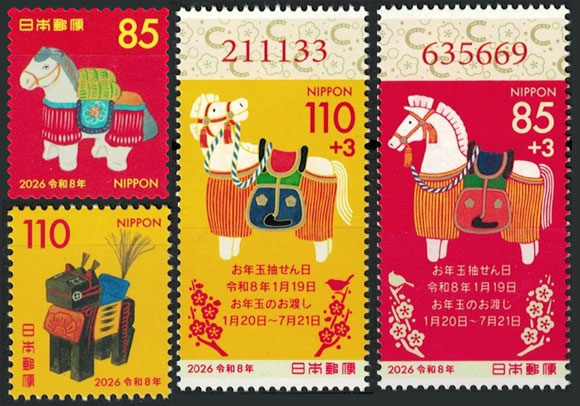
30.10.2025
On October 30, 2025, Japan Post issued a series of postage stamps for the Year of the Horse.
Traditionally, in the lead-up to the New Year, Japan Post issues stamps featuring the symbols of the year according to the Chinese lunar calendar. The series consists of four stamps: two regular stamps and two charity stamps with numbers for the New Year's lottery.
The designs for the stamps were based on drawings by Japanese artist Kawasaki Kyōsen.
Kawasaki Kyōsen (1877–1942) was an artist and illustrator known for his drawings of traditional Japanese toys and handicrafts. In the early 1900s, he traveled extensively throughout Japan, studying, cataloging, and capturing traditional toys and arts and crafts from different regions of the country.
Researchers estimate that Kyosen played a key role in preserving information and visual representations of traditional applied arts. He created 52 albums containing over 5,000 drawings of folk toys, many of which are known today only through his work. A separate album was dedicated to animal figurines—the annual symbols of the Chinese lunar calendar. Kawasaki Kyosen's drawings of clay, wood, and paper figurines and toys are highly detailed, yet lively and expressive. He didn't simply depict objects; he systematized them, indicating their region of origin and artist, their purpose, traditional use, and ritual significance.
Japan Post has been using Kawasaki Kyosen's drawings for its New Year stamps since 2020.
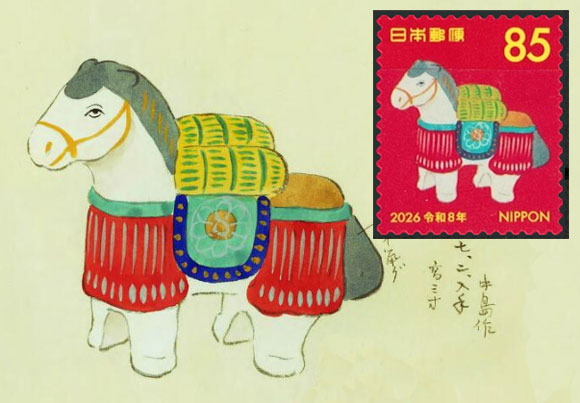
The 85 yen stamp depicts a clay figurine, "Tawara Uma" (a horse with sacks of rice), from the Masumida Shrine in Ichinomiya, executed in the old style. Craftsmen from the Okoshi and Tomita districts handcrafted toys from local clay, then fired them and painted them with vibrant colors. The technique for producing these clay dolls was passed down from generation to generation. Okoshi toys have been designated as an intangible cultural asset of the city of Ichinomiya.
Horse figurines with sacks of rice on their backs were created as good luck charms, symbolizing good fortune, business prosperity, and bountiful harvests.
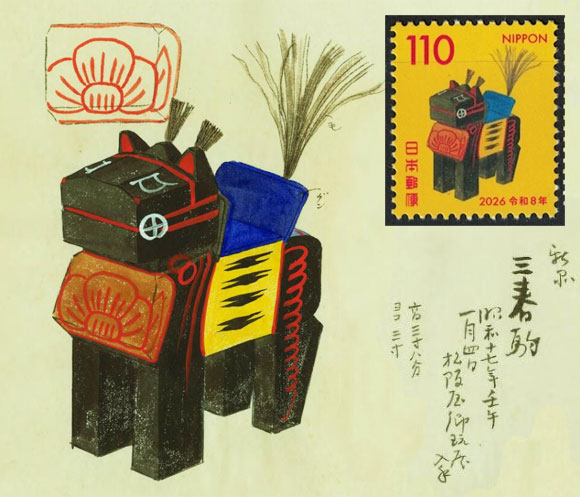
The 110 yen stamp features a wooden horse called "Miharu-Koma." The making of these angular, brightly painted wooden horses is a traditional folk craft in the city of Miharu in Fukushima Prefecture. This ancient Japanese art has a history dating back 1,500 years. The tradition of making "Miharu-Koma" is linked to the legend of the general Sakanoue no Tamuramaro. According to one version, a magical wooden horse helped him, and since then, such figurines have been considered good luck and protection, and they are also believed to convey requests and messages to the gods.
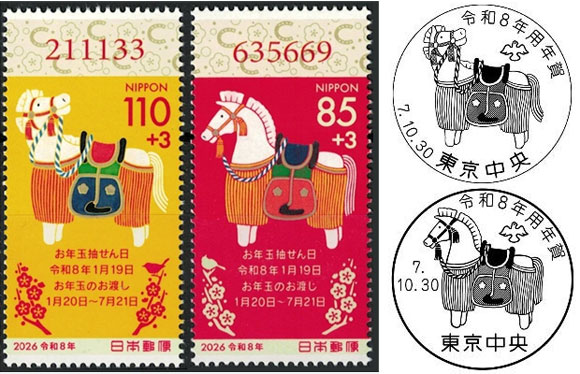
Two semi-postal stamps (82 + 3 yen and 110 + 3 yen) also feature images of decorative horses. I couldn't find any further information about whether they have real prototypes. This is likely an original drawing by designer Ayumi Yoshikawa.
But what's more interesting about these stamps is that they aren't just stamps, but lottery tickets in the traditional New Year's lottery held by Japan Post. A unique number is printed at the top of each stamp. The lottery results will be published on the Japan Post website on January 19, 2026. Three lucky winners will receive: 1) a cash prize, 2) a gift from a special Japan Post catalog, 3) souvenir sets of postage stamps.
Originally, special New Year's cards were used in the postal lottery. Japan has a wonderful tradition called "nengajō"—sending greeting cards to all relatives, friends, and colleagues before the New Year, so that they can be received on January 1st. To achieve this, the post office prints large quantities of New Year's greeting cards. In 1949, Japan Post decided to give all users an extra New Year's gift and organized a lottery, adding unique numbers to postcards.
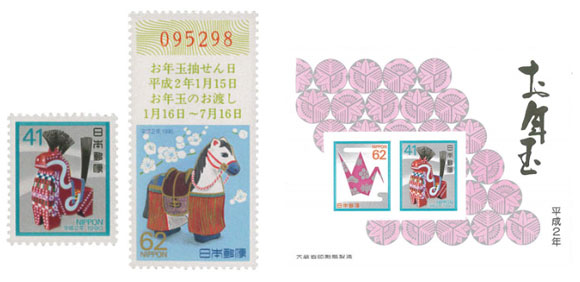
New Year's lottery stamps appeared much later: on December 1, 1989. Stamps honoring the Year of the Horse 1990 (and featuring horses!) were printed with numbers and entered into the New Year's lottery.
Conducting a lottery using postcards and stamps is a unique phenomenon in the world of postage and philately; it exists only in Japan.
Sources: post.japanpost.jp, yushu.or.jp
This text has been translated using Google Translate
I apologize for any errors or inaccuracies
I apologize for any errors or inaccuracies